Ask any teacher how they spend their Sunday evenings, and a common answer emerges: searching. Searching for the right lesson resource.
Ask any teacher how they spend their Sunday evenings, and a common answer emerges: searching. Searching for the right lesson resource. Searching for the pacing guide to confirm what should be taught this week. Searching for the supplemental material that connects the curriculum unit to the assessment. Searching for the login credentials to the platform that has the video they know is somewhere in the system.
This is the hidden weekly tax on classroom instruction — and it is costing districts far more than they realize.
The anatomy of the search problem
In the average K-12 classroom, a teacher is expected to deliver instruction that is aligned to the district’s adopted curriculum, paced according to the district’s scope and sequence, supported by instructional resources that meet diverse learner needs, and connected to assessment data that should be informing their decisions week to week.
Each of those elements typically lives in a different place. The curriculum might be in one publisher’s portal. The pacing guide might be in a shared Google Drive. The supplemental resources might be in a separate platform. The assessment data is somewhere in the student information system. And the tools the district purchased to support ELL students might require yet another login.
Before a teacher has taught a single lesson, they have navigated a logistical maze that would challenge any professional. Under time pressure — and teachers are always under time pressure — this maze produces predictable outcomes: shortcuts, substitutions, and simplifications that quietly erode the quality of instruction the district intended to provide.
What the research tells us
Studies consistently show that teachers spend between six and twelve hours per week on lesson planning and preparation. A significant portion of that time is not spent on the intellectually valuable work of thinking about students and designing instruction — it is spent on logistics. Finding materials. Aligning resources. Confirming pacing. This is what practitioners have begun calling the “Time Tax”: the hours extracted from teaching by the systems failures of fragmented instructional infrastructure.
The Time Tax is not evenly distributed. Experienced teachers have developed workarounds. They have curated their own libraries, built their own shortcuts, and created personal systems for navigating the fragmentation. New teachers, those working in underfunded schools, and those serving the district’s most complex student populations face the full weight of the burden every week.
The instructional cost
When teachers are exhausted by the logistics of finding materials, they make different instructional decisions than they would if the path to excellent teaching were clear. They choose the lesson that is easiest to access, not necessarily the one most aligned to the curriculum. They skip the differentiated resource because finding it takes too long. They default to worksheets because worksheets are always available.
None of these decisions are failures of character or commitment. They are rational responses to an irrational system. But the cumulative instructional cost — the lessons that are less rigorous, the students who receive less support, the curriculum that is nominally adopted but operationally inconsistent — is borne entirely by students.
What a different system looks like
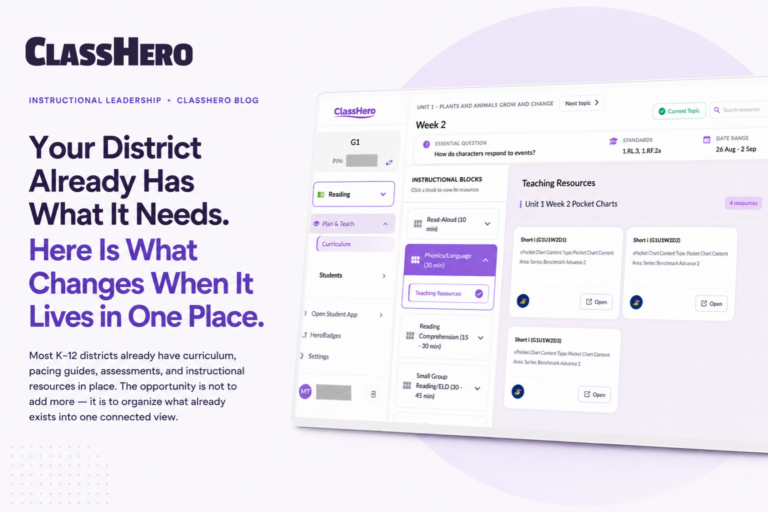
The solution to the search problem is not asking teachers to be more organized. It is building systems in which the work of searching has already been done — where the curriculum, its resources, the pacing logic, and the supporting materials are available together, in one place, aligned to what a teacher needs to teach this week.
When that infrastructure exists, preparation time shrinks dramatically. Teachers spend their planning hours on teaching decisions, not logistics decisions. And the quality of instruction — across classrooms, across schools, across the district — rises accordingly.
The hours teachers spend searching are not an individual productivity problem. They are an organizational systems problem. And like all systems problems, they have a systems solution. The question is whether district leaders are ready to treat teacher time as the instructional resource it actually is.