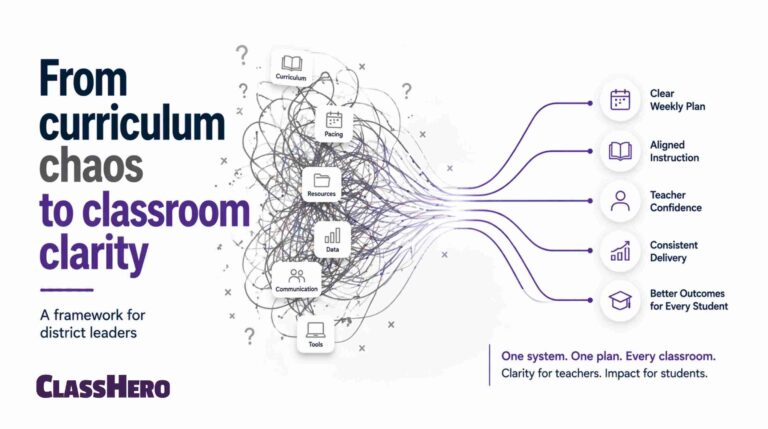
Most districts don’t have a curriculum problem—they have an implementation gap. The issue isn’t teachers, it’s disconnected systems. When planning and execution don’t align, consistency—and student outcomes—suffer.
If you ask most district leaders whether they have a strong curriculum, the answer is yes. If you ask whether that curriculum is being delivered consistently and with fidelity across every classroom every day, the answer becomes considerably less certain.
The space between those two answers is the curriculum implementation gap. And for superintendents who are serious about student outcomes, understanding it — and closing it — may be the highest-leverage work available to them.
A working definition
The curriculum implementation gap is the difference between what a district intends for students to experience academically and what students actually experience in their classrooms on a daily basis.
It is not a measure of teacher quality. It is not an indicator of curriculum weakness. It is a structural gap that exists in virtually every district, created by the distance between the central office decisions that shape instructional vision and the daily classroom realities that determine whether that vision is realized.
In practice, the implementation gap looks like this: a district adopts a rigorous math curriculum with strong evidence behind it. Teachers are trained. Materials are distributed. Pacing guides are developed. And then, six months later, the curriculum is being delivered with full fidelity in some classrooms, with partial fidelity in others, and with minimal connection to the adopted program in a meaningful percentage of rooms across the district.
Why the gap exists
The implementation gap is not primarily a motivation problem. Most teachers want to deliver excellent instruction. The gap exists because the systems that should support consistent delivery are typically inadequate.
Curriculum materials, pacing guides, instructional resources, and assessment tools usually live in separate systems that are not integrated with one another. Teachers must navigate multiple platforms to prepare a single week of instruction. The result is friction — and friction, under the daily pressures of classroom teaching, almost always leads to simplification.
When accessing the full curriculum requires navigating three platforms, teachers simplify. When the connection between pacing and daily instruction is unclear, teachers fill the gap with their own judgment. When new or less experienced teachers lack the institutional knowledge to navigate the system efficiently, the gap widens further.
The implementation gap is, at its core, a systems problem dressed up as an execution problem.
Why superintendents should care
The curriculum implementation gap matters to superintendents for three interconnected reasons.
First, it determines the return on curriculum investment. Districts spend significant resources selecting, purchasing, and training teachers on high-quality instructional materials. If those materials are not being consistently delivered, the return on that investment is dramatically diminished — regardless of the quality of the materials themselves.
Second, it drives outcome variability. When implementation fidelity varies significantly across classrooms and schools, student outcomes will vary accordingly. The implementation gap is one of the most significant drivers of within-district equity gaps — gaps that are often attributed to student demographics but are actually the result of inconsistent instructional access.
Third, it is solvable. Unlike many challenges facing district leaders, the implementation gap is a systems problem with systems solutions. It does not require replacing teachers, adopting new curricula, or restructuring schools. It requires building better infrastructure for curriculum delivery — infrastructure that makes the path to consistent, high-quality instruction the path of least resistance for every teacher in the system.
The superintendent’s role
Superintendents cannot close the implementation gap through willpower or professional development alone. What they can do is create the conditions under which consistent delivery becomes possible — by investing in the connective infrastructure that turns an adopted curriculum into a daily classroom reality.
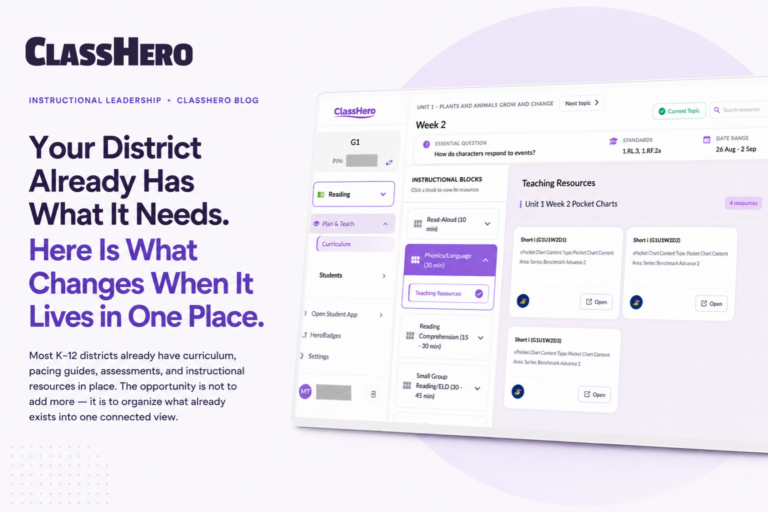
That means ensuring that teachers have a clear, unified view of what they are expected to teach, when they are expected to teach it, and what resources support that instruction. It means giving school and district leaders the visibility to know whether the curriculum is being delivered as intended. And it means treating implementation not as a post-adoption afterthought but as the central challenge of instructional leadership.
The gap between great curriculum and great teaching is not inevitable. But closing it requires knowing exactly what it is — and deciding that closing it is worth the effort.
Ready to bring instructional clarity to your district? Book a demo at classhero.com