Between a district’s instructional vision and the classroom door, something often gets lost. Not because of poor decisions or lack of effort — but because the infrastructure connecting the two was never fully built. Here is a practical framework for closing that gap.
Most K–12 districts already have curriculum, pacing guides, assessments, and instructional resources in place. The opportunity is not to add more. It is to organize what already exists into one connected view — and to understand what changes when that happens.
The short answer: When a district’s curriculum, pacing guides, assessments, and instructional resources are organized into one place, the starting point for every teacher becomes clear. Nothing new is introduced. Everything that already exists simply becomes easier to use.
Most Districts Already Have What They Need
Most districts already have what they need to deliver strong instruction.
The curriculum is in place. Pacing guides are defined. Assessments are aligned. Instructional resources have been carefully selected and approved over time.
None of this is missing. The work has already been done.
The question is not whether the materials are strong. They are. The question is how clearly they come together for every teacher, every week.
The Materials Are There. They Just Don’t Always Live Together.
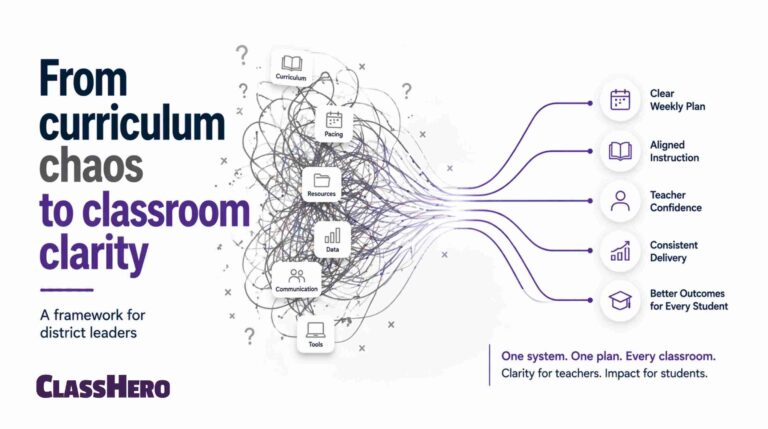
In most districts, curriculum, pacing guides, assessments, and instructional resources exist across multiple systems and platforms. Each one was adopted intentionally. Each one serves a purpose.
But they don’t always live in the same place.
That separation is not a reflection of poor planning. It is simply the result of how instructional systems have grown over time — each component added thoughtfully, each living where it made sense when it was introduced.
The opportunity is not to question what exists. It is to bring it together.
This Is Not a Curriculum Problem
It is important to be clear about what this is not.
This is not a curriculum problem. Districts are not lacking materials, programs, or direction. In most cases, they already have all of that in place — the result of years of careful decisions and significant investment.
The opportunity is not to add more. It is to make what already exists easier to access and use as a complete system.
When curriculum, pacing guides, and resources live in different places, accessing them requires coordination across systems — coordination that happens every week, before instruction can begin. That coordination is a function of structure, not of effort or capability.
Changing the structure changes what is possible.
What Changes When Everything Lives in One Place
When curriculum, pacing guides, assessments, and instructional resources are organized into one connected view, something specific changes.
The starting point becomes clear. Materials are already connected to the pacing guide. The structure of the week is visible without searching across systems.
Nothing new is introduced. There are no additional programs to learn. Everything that already exists is organized into a single, coherent view — one that every teacher in the district can open on Monday and use immediately.
That shift is quiet. But it changes how the entire system works.
Most Districts Don’t Need More. They Need What They Already Have to Work Together.
The materials are already there. The structure already exists.
When everything lives in one place, that structure becomes visible — and usable — in a way it cannot be when it is spread across systems.
This is not about replacing decisions that have already been made. It is about making those decisions more accessible in practice, for every teacher, every week.
Your district already has what it needs.
ClassHero brings it all into one place.
→ See how it works: classhero.com