Between a district’s instructional vision and the classroom door, something often gets lost. Not because of poor decisions or lack of effort — but because the infrastructure connecting the two was never fully built. Here is a practical framework for closing that gap.
Most district leaders did not set out to create instructional complexity. The curriculum adoptions made sense at the time. The technology purchases addressed real needs. The professional development investments were well-intentioned. And yet, somewhere between the central office’s instructional vision and the classroom door, coherence can erode — quietly, gradually, and at real cost to students.
The path from complexity to clarity is not mysterious. But it requires a framework for thinking about the problem that most districts have not yet fully adopted.
Step one: Name the actual problem
The first step is naming the problem accurately. In most districts, the challenge is not the curriculum itself. It is the delivery system — or more precisely, the connective infrastructure between what has been adopted and what reaches classrooms daily.
A delivery system is the infrastructure that connects an adopted curriculum to daily classroom instruction. It includes how teachers access materials, how pacing guidance is communicated, how resources are organized, and how leaders can see whether the curriculum is being delivered as intended. Without a delivery system, the curriculum remains a policy aspiration rather than a daily classroom reality. The most useful question to ask is not ‘is our curriculum strong enough?’ but ‘does our delivery system support the curriculum we have?’
Step two: Map the teacher experience
The second step is to map, specifically, what a teacher in your district experiences when they prepare a week of instruction. How many platforms do they need to access? How is the pacing guide surfaced in their planning process? What does a new teacher experience in their first week navigating these systems?
This mapping exercise almost always reveals that the experience is more complex, more fragmented, and more dependent on informal knowledge than district leaders expected. That complexity is a design opportunity — and design problems can be solved.
Step three: Define what clarity looks like
Clarity means that every teacher has a simple, unified, and accurate answer to the question: what am I teaching this week, and what do I need to teach it well?
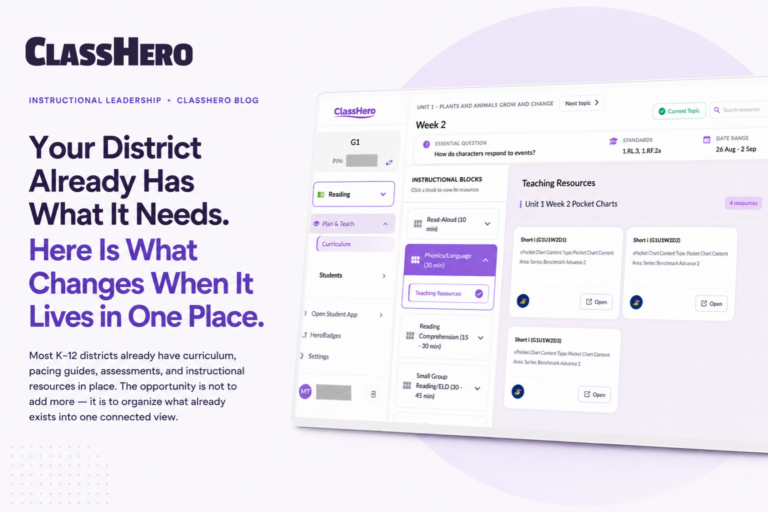
That sounds simple. In most districts, it requires intentional infrastructure to achieve. Clarity means a teacher can access their weekly instructional plan, curriculum materials, pacing guidance, and supporting resources in one place. It means a substitute teacher can pick up where the regular teacher left off. It means a new teacher in their first month can deliver with the same fidelity as a veteran in their tenth year.
Step four: Build for the most constrained user
The most important design principle for instructional infrastructure is to build for the most constrained user. The veteran teacher who has been at the same school for fifteen years will find ways to make almost any system work. The first-year teacher, the substitute, the educator managing a particularly complex student population — these are the users whose experience should define the system.
When instructional infrastructure is designed for the most constrained user, it works for everyone. When it is designed for the most resourceful user, it inadvertently leaves the most vulnerable teachers — and by extension, their students — without the support they need.
Step five: Treat clarity as a continuous standard
Classroom clarity is not a project with an end date. It is a standard that requires ongoing attention. Curricula change. Pacing guides are updated. New teachers arrive. New platforms are adopted. Each of these events creates new opportunities for fragmentation to re-enter the system.
Districts that maintain instructional clarity over time treat delivery infrastructure as a standing operational priority — not a one-time initiative, but a core function of instructional leadership that is owned, measured, and continuously improved.
The path from curriculum complexity to classroom clarity is available to every district. It does not require replacing what exists. It requires building the connective infrastructure that turns everything already in place into a coherent, consistent, and equitable instructional experience for every student, every day. That is the work. And it is entirely worth doing.
Ready to bring instructional clarity to your district? Book a demo at classhero.com