District leaders make significant investments in instructional quality. The curriculum adoption. The materials. The professional development. The technology platforms. These decisions reflect a genuine commitment to students — and they represent real organizational effort and resources.
District leaders make significant investments in instructional quality. The curriculum adoption. The materials. The professional development. The technology platforms. These decisions reflect a genuine commitment to students — and they represent real organizational effort and resources.
What is often missing from those conversations is the return side of the equation. Not because district leaders are not interested in outcomes, but because the connection between delivery infrastructure and the value those investments produce is rarely made explicit. That connection is where much of the opportunity lives.
Unlocking the value that’s already there
Every high-quality curriculum is designed to produce specific outcomes — in student learning, in instructional coherence, in teacher confidence. That value is built into the materials. But it does not emerge from the adoption decision. It emerges from delivery: consistent, well-supported delivery in every classroom where the curriculum has been adopted.
When delivery infrastructure is strong, districts capture more of the value their curriculum was designed to produce. When it is incomplete, that value remains unrealized — not because the district made wrong choices, but because the connective infrastructure between the adoption and the classroom has not yet been fully built. Closing that gap is not a corrective measure. It is the completion of the investment the district already made.
This reframe matters. Most districts are not failing at implementation. They are operating with infrastructure that was not built to support the level of consistency their curriculum requires. ClassHero is built to close that gap — to connect what districts have already invested in with the daily classroom experience their students deserve.
The human capital dimension
The return on strong implementation infrastructure is not only instructional. It is also human.
Teachers who have what they need to teach well — clear weekly guidance, accessible materials, a unified view of the curriculum they are expected to deliver — spend less time on logistics and more time on students. That experience of effectiveness matters enormously for retention. Research consistently shows that teachers are significantly more likely to stay in schools where they feel equipped and supported.
When implementation infrastructure is strong, it becomes a form of teacher support — one that does not require additional coaching hours or professional development days. It is built into the daily experience of planning and delivering instruction. The teachers who benefit most are those who need it most: new educators, those working in high-turnover schools, and those serving the district’s most complex student populations.
The student outcome case
The most meaningful return on strong implementation infrastructure shows up in student outcomes. When every classroom has consistent access to rigorous, well-sequenced instruction, the compounding effect over a school year is substantial.
Research on HQIM implementation consistently finds that classrooms with high fidelity outperform those with low fidelity — even when using the exact same curriculum. The materials matter. Delivery matters more. A district that has invested in strong curriculum and builds the delivery infrastructure to support it is creating the conditions for those investments to compound: better instruction, stronger retention, more consistent outcomes across schools and classrooms.
Implementation as a multiplier
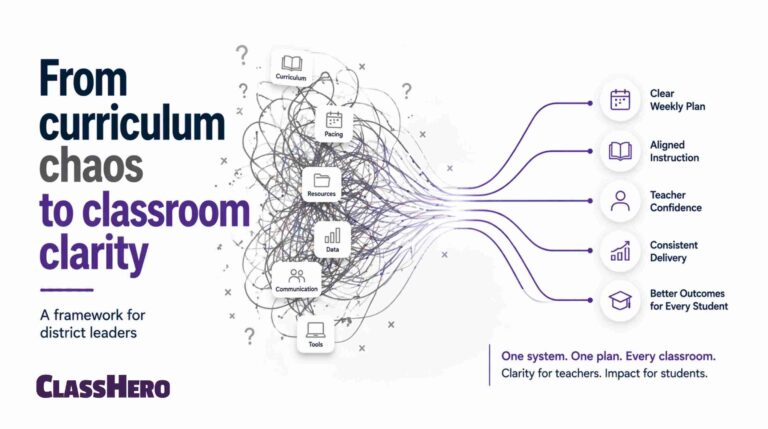
The most useful way to think about delivery infrastructure is as a multiplier on every instructional investment a district has already made. The curriculum is the foundation. The delivery system determines how much of that foundation reaches students.
Districts that build strong delivery infrastructure are not adding a new initiative to an already full plate. They are ensuring that the initiatives already in place — the curriculum adoption, the professional development, the technology investment — produce the returns they were always capable of producing. ClassHero’s role is to be that multiplier: connecting what exists into a coherent, consistent, high-fidelity instructional experience for every teacher and every student.
The conversation worth having
The most productive budget conversation a district leadership team can have is not only about what to adopt next. It is about whether the investments already made are reaching their full potential.
That is the conversation ClassHero is built to support — not as a critic of what has been done, but as a partner in ensuring that the work districts have already invested in reaches the students it was always meant to serve. The value is there. The intention is there. The infrastructure is what brings them together.