When student outcomes fall short of expectations, the temptation is to look at the curriculum. Perhaps the materials are not rigorous enough. Perhaps the program is not well suited to the district’s student population. Perhaps it is time to revisit the adoption.
When student outcomes fall short of expectations, the temptation is to look at the curriculum. Perhaps the materials are not rigorous enough. Perhaps the program is not well suited to the district’s student population. Perhaps it is time to revisit the adoption.
Before making that call, it is worth asking a different question: is the curriculum actually being delivered? Because in many cases, the problem is not the program — it is the pipeline. Here are five signs that your district may have a curriculum delivery problem rather than a curriculum problem.
1. Teacher familiarity with the curriculum varies dramatically across your schools
When you visit different schools in your district and ask teachers about the curriculum, do you get the same story? Or do you find that teachers in some schools have deep command of the materials, while teachers in others are using the adopted curriculum intermittently at best?
Dramatic variation in teacher familiarity with the same curriculum is a reliable indicator of delivery infrastructure failure. It does not mean some teachers are better than others. It means some schools have developed informal systems for navigating the curriculum while others have not — and the district’s central infrastructure has not filled that gap.
2. Pacing guides exist but are rarely referenced in planning
The pacing guide is one of the most important documents a district produces, yet in many districts it functions more as a policy artifact than a daily planning tool. If your instructional coaches report that teachers are rarely consulting the pacing guide when planning, or if the pacing guide has not been updated to align with recent curriculum changes, you have a delivery problem.
Pacing guides only influence instruction if they are accessible, current, and connected to the daily planning process. A pacing guide that lives in a shared drive folder most teachers never open is not a delivery system. It is a good intention that never became operational.
3. Curriculum materials are scattered across multiple platforms
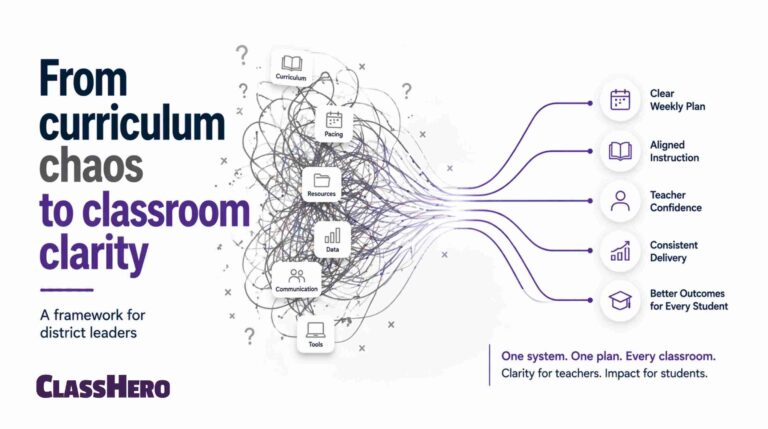
Count the number of platforms a teacher in your district must access to prepare a complete week of instruction. If the number is three or more — and in many districts it is closer to five or six — you have a structural delivery problem.
When curriculum materials, supplemental resources, pacing guidance, and assessment tools are fragmented across disconnected systems, teachers will optimize for convenience. The most accessible material will win, regardless of its alignment to the district’s instructional priorities. This is not a teacher motivation problem. It is an information architecture problem.
4. You have limited visibility into whether the curriculum is being taught
If a district leader asked you today whether your adopted curriculum is being implemented with fidelity across your schools, how confident would you be in your answer? If the honest answer is “I believe so, based on walkthrough observations and test scores,” that is a visibility gap.
Real visibility into curriculum delivery means knowing — not believing — whether teachers are accessing curriculum materials, whether pacing is aligned, and whether the instructional sequence is being followed. Without that visibility, leaders are making important decisions based on proxies rather than evidence.
5. New and substitute teachers struggle significantly more than veterans
Every district has veteran teachers who have mastered the art of navigating instructional complexity. They have built personal systems, curated their own resource libraries, and developed the institutional knowledge to find what they need efficiently. But if the systems that support instruction are only navigable by veterans — if new teachers, substitute teachers, and teachers in their first years at a campus consistently struggle to access what they need — the delivery infrastructure is fundamentally broken.
A delivery system that depends on institutional memory to function is not a system. It is an informal network that excludes everyone who has not yet been invited in.
What these signs point to
If your district recognizes itself in two or more of these signs, the instinct to consider a curriculum replacement is understandable. But replacing the curriculum without fixing the delivery infrastructure will reproduce the same problems with a different set of materials.
The more productive path is to diagnose the delivery system honestly, identify where the pipeline is broken, and build the infrastructure that makes consistent, high-fidelity instruction possible for every teacher, in every school, every day. The curriculum you have may be exactly the right curriculum. What it needs is a delivery system worthy of it.