Districts have never invested more in educational technology. Yet at the system level, the instructional impact often falls short of what was promised. This is not a technology problem. It is an integration problem — and solving it starts with asking a different question.
The K-12 education technology market has grown dramatically over the past decade. Districts have invested heavily in learning management systems, assessment platforms, digital curriculum tools, data dashboards, communication applications, and an expanding catalog of AI-powered learning tools. The spending reflects genuine commitment to improving outcomes. The results, at the system level, have not yet matched that commitment.
This is not a technology problem. It is an integration problem. And understanding it clearly is essential for any district leader making decisions about where to invest next.
The accumulation challenge
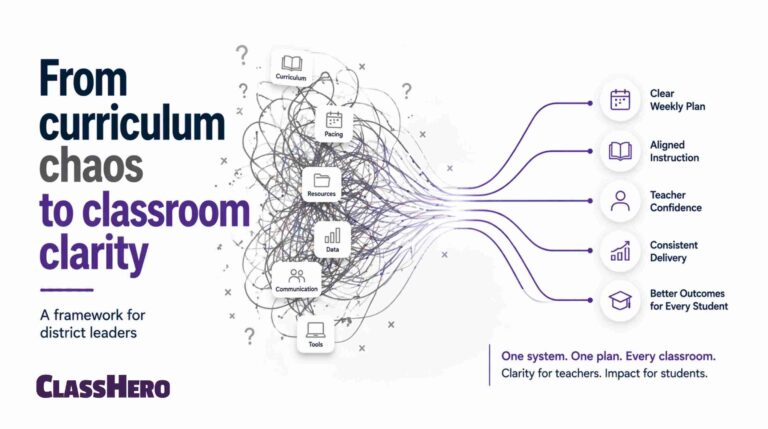
Most districts have built a technology ecosystem over time — a collection of tools added in response to different needs, at different moments, by different administrators. Each addition was reasonable in context. Together, they have created something that is technically sophisticated and operationally complex: platforms that do not communicate with one another, data that cannot move between systems, and teachers navigating more tools than any one person can use consistently.
The result is that the overall instructional effect of those investments is often far less than the sum of their individual value. Not because the tools are poor, but because the system that would allow them to work together has not been built.
Why tools without integration underperform
A tool that is not integrated into a teacher’s daily workflow is a tool that will not be used consistently. This is a behavioral reality, not a reflection on teacher professionalism.
Consider a teacher who has been given access to a high-quality digital curriculum platform, a separate assessment tool, a student information system, a grade book application, and two or three additional resources. Each of these tools may be genuinely valuable. But if accessing them requires separate logins, separate contexts, and separate planning processes, the cognitive overhead of using them all consistently is prohibitive. Teachers make rational decisions about their time and attention — and the tools that get used are the ones that are easiest to access, not necessarily the ones that best support instruction.
The adoption versus utilization gap
Districts typically measure technology success in adoption — accounts created, licenses purchased, professional development sessions completed. Utilization — whether the tools are actually being used in ways that influence instructional decisions — is rarely measured with the same rigor.
The gap between adoption and utilization is where much of the investment’s potential goes unrealized. A district can have near-complete adoption of a curriculum platform and still see limited instructional impact, simply because the conditions for consistent use were never established.
What distinguishes effective edtech investment
Districts that extract meaningful value from technology investment tend to share a common characteristic: they invest in integration rather than addition. Rather than continuing to expand an already complex tool ecosystem, they focus on ensuring that the tools they have are connected — that the curriculum platform informs the planning process, that pacing data is visible where teachers need it, that the resources for this week’s instruction are accessible without navigating multiple applications.
Integration is not the most visible investment a district can make. It does not generate the excitement of a new platform launch. But it is the work that determines whether the technology already purchased produces the instructional impact it was designed to produce.
The question worth asking first
Before the next technology purchase, before the next platform evaluation, the most productive question a district leader can ask is this: do the tools we already have work together in a way that supports consistent, high-quality instruction? If the honest answer is not yet, the highest-return investment available may not be a new tool. It may be the infrastructure that allows existing tools to function as a coherent system.
The promise of educational technology has always been better instruction for more students. Building the integration infrastructure that allows that promise to be realized is not the most glamorous work in district leadership. It may be the most important.
Ready to bring instructional clarity to your district? Book a demo at classhero.com