Why teacher planning needs a strategic transformation, backed by national research.
A Strategic Opportunity for School Districts
In today’s educational ecosystem, time has become one of the most valuable — and often most fragmented — resources in a school district.
National surveys from organizations such as Educators for Excellence, Merrimack College, the National Education Association, and RAND consistently highlight a common reality: teachers frequently work beyond their contracted hours.
Research from the Merrimack College Teacher Survey, conducted in partnership with the EdWeek Research Center, reports that teachers work an average of 54 hours per week. At the same time, studies examining teacher workload show that only a portion of this time is spent on direct instruction.
A significant amount of teacher time is dedicated to planning, preparation, grading, and navigating instructional resources across multiple systems.
These hours are often invisible within district planning conversations, but they represent an important opportunity to strengthen instructional focus.
“Teachers are not running out of dedication — they are running out of time.”
The Invisible Hours of Teaching: Reclaiming Time for Instruction
Lesson planning rarely begins with pedagogy.
Instead, teachers often begin with a series of logistical steps:
- Locating the correct curriculum resource aligned to the day’s standard.
- Verifying that textbooks, digital activities, and assessments follow district pacing guides.
- Adapting lessons for multilingual learners or Tier 2 supports.
- Navigating multiple platforms to gather instructional materials.
Each step is understandable within a modern educational system.
However, together they create operational friction that consumes valuable planning time.
Research from RAND’s American Instructional Resources Survey (AIRS) highlights how teachers frequently rely on multiple instructional resources and platforms to prepare lessons. When materials are spread across systems, coherence and alignment can become more difficult to maintain.
Reducing this complexity can help teachers focus on the most important part of their work: designing meaningful learning experiences.
“Instructional excellence should not begin with a search bar.”
The Invisible Hours of Teaching: Reclaiming Time for Instruction
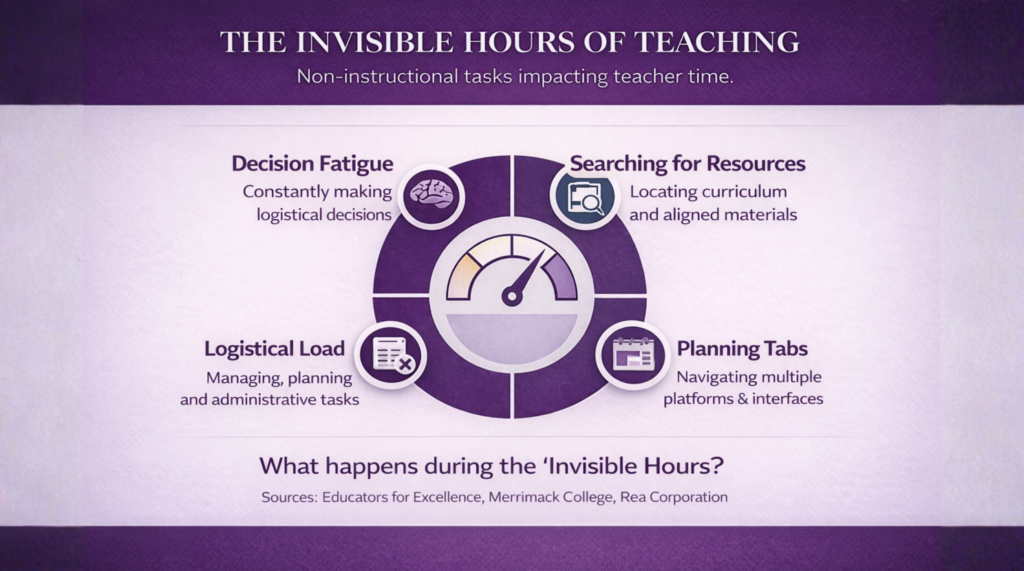
Another factor that influences instructional planning is cognitive load.
Organizational psychology often describes a phenomenon known as decision fatigue, where repeated decision-making gradually reduces the quality and efficiency of later decisions.
Research discussed by the American Psychological Association shows that high cognitive demands and stress can interfere with decision-making processes.
In the context of education, teachers make dozens — sometimes hundreds — of small decisions during the planning process.
Not pedagogical decisions, but logistical ones.
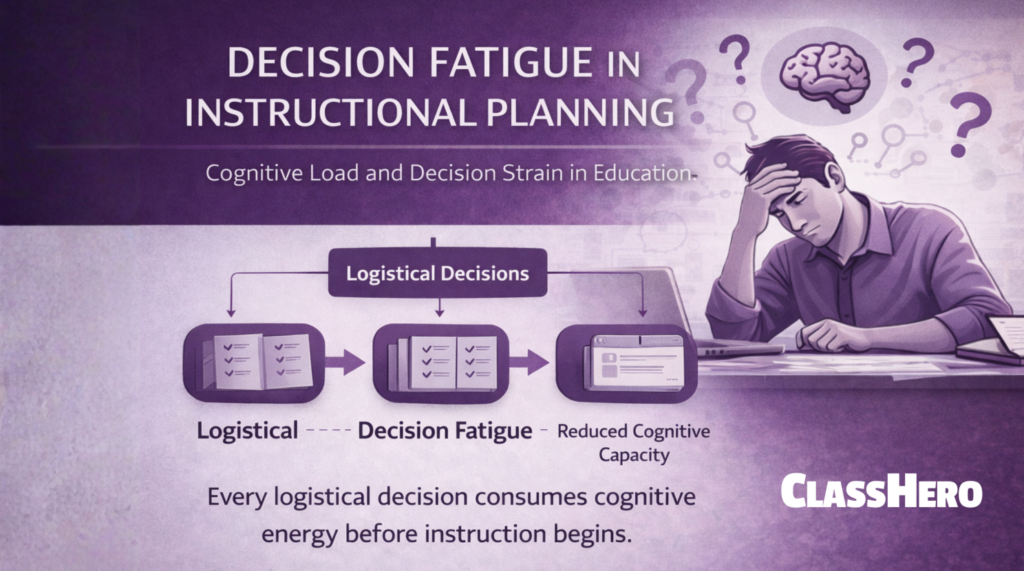
When significant mental energy is spent navigating systems and locating materials, teachers may have less cognitive space available for deeper instructional design.
Simplifying planning workflows can help protect teachers’ cognitive capacity for the moments that matter most: engaging students, asking meaningful questions, and adapting instruction to learning needs.
From Logistics to Instructional Strategy
When districts reduce logistical friction in planning workflows, the benefits extend beyond efficiency.
Teachers can shift their focus from logistics to instructional strategy.
This creates more time for:
- Analyzing student performance data.
- Designing high-quality questions and learning activities.
- Personalizing instruction.
- Providing meaningful feedback to students.
Over time, this shift supports stronger instructional consistency across classrooms.
Protecting teachers’ time is not simply a matter of convenience — it is a strategic investment in instructional quality.
Supporting Instructional Clarity Across Districts
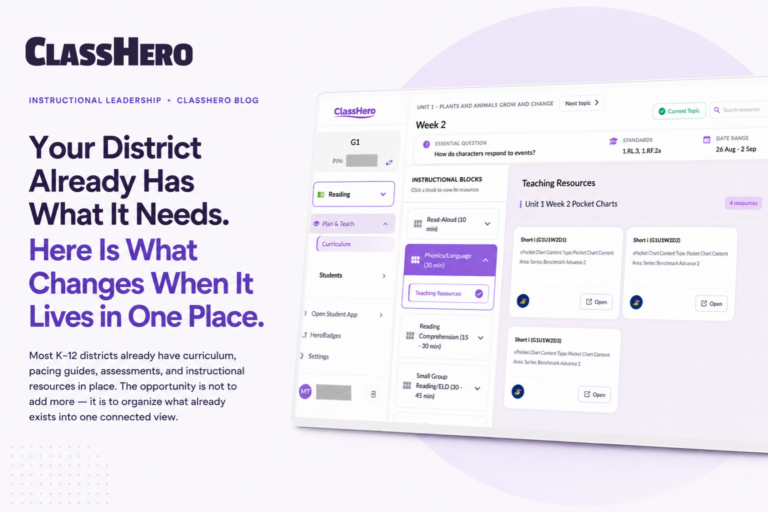
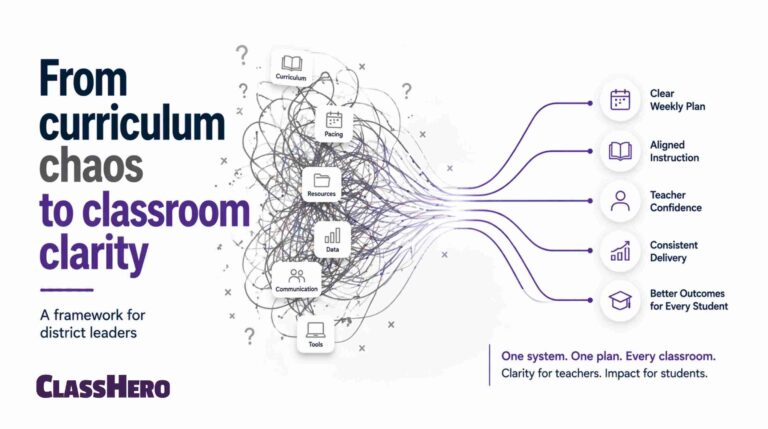
Many districts are beginning to explore ways to simplify instructional planning by organizing the curriculum resources they have already adopted.
Solutions like ClassHero aim to support this effort by aligning district-adopted curricula — such as HMH, Eureka, or Fundations — into a more streamlined workflow aligned with district pacing.
By reducing the need to navigate across multiple systems, these approaches can help return valuable planning time back to instruction.
The goal is not to add more initiatives, but to make the systems teachers already use easier to navigate
“Improving instruction doesn’t always require adding more initiatives — sometimes it begins by simplifying the systems teachers already use.”
Returning Time to the Classroom
Across the country, district leaders are increasingly recognizing that one of the most powerful ways to strengthen instructional outcomes is to protect teachers’ time.
When planning systems are simplified, teachers gain the space to focus on what they do best: teaching, supporting students, and creating meaningful learning experiences.
The question for district leaders is becoming clearer:
How much instructional time could be returned to the classroom if planning logistics were simplified?
References
Educators for Excellence. (2024). Voices from the Classroom: A Survey of America’s Educators. https://e4e.org/what-we-do/a-survey-of-americas-educators/voices-from-the-classroom-2024-a-survey-of-americas-educators/
Merrimack College & EdWeek Research Center. (2023). Merrimack College Teacher Survey. https://www.merrimack.edu/academics/education-and-social-policy/merrimack-college-teacher-survey/
Education Week. How Teachers Spend Their Time: A Breakdown. https://www.edweek.org/teaching-learning/how-teachers-spend-their-time-a-breakdown/2022/04
National Education Association. Survey: Teachers Work More Hours Per Week Than Other Working Adults. https://www.nea.org/nea-today/all-news-articles/survey-teachers-work-more-hours-week-other-working-adults
American Psychological Association. Stress and Decision-Making Research. https://www.apa.org/monitor/2022/06/news-pandemic-stress-decision-making
Economic Policy Institute. The Teacher Shortage and Working Conditions. https://www.epi.org/publication/shortage-of-teachers/